2026 · STRATEGY
Accessibility breeds selectivity
A pattern I have been watching in how founders decide what is worth doing.
The old request
For most of the time I have spent around small businesses, the request arrived in the same shape. A founder needed a website. Or they should be on social media. Or it was time to start running ads.
The request was for a capability, and it rarely came with an account of what the capability was for. So the conversation had to go backwards before it could go forwards, usually by asking what the business was actually trying to achieve and what would have to be true a year later for this to have been worth doing.
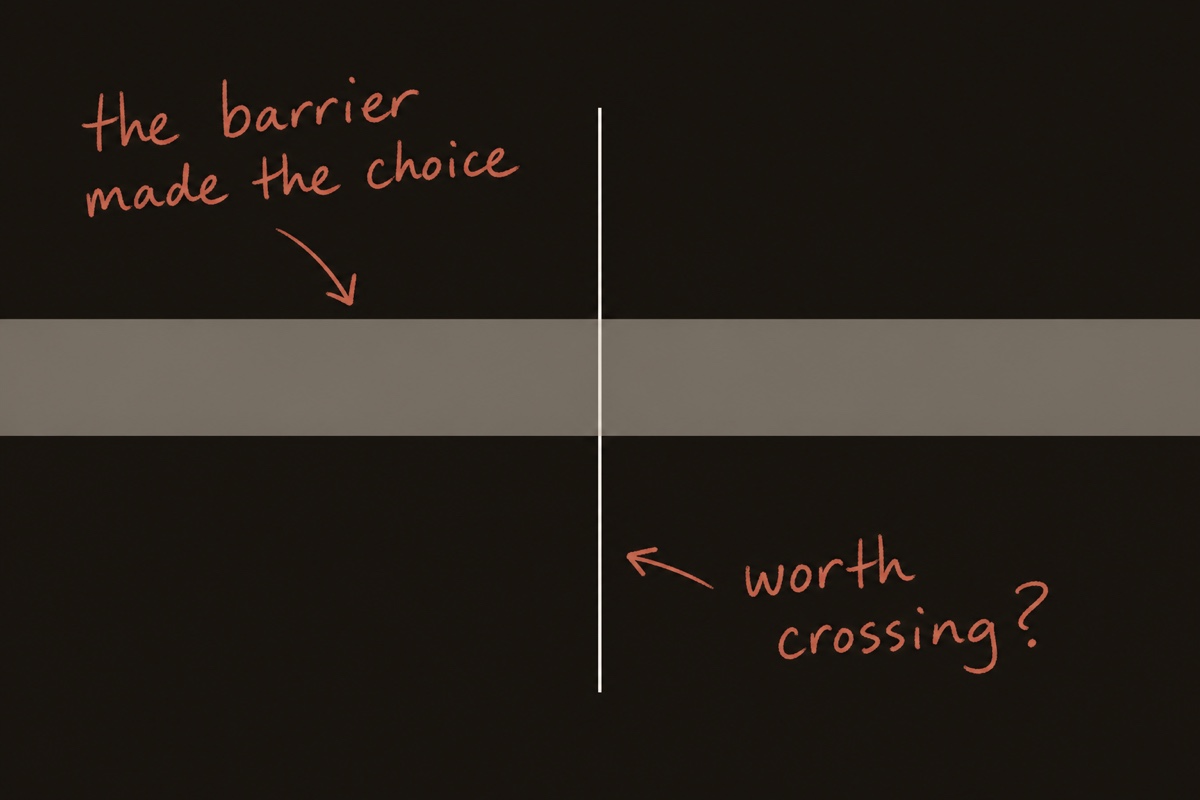
That questioning had to come from outside, because nothing in the situation produced it. A website was expensive, slow, and needed people the business did not employ. Wanting one felt like reason enough. The difficulty of the thing supplied the reason to do it.
The barrier did two jobs at once. It cost money, and it decided what the business would not attempt.
What changed
The removal of that barrier is well covered and does not need arguing here. What is worth separating are two ideas that usually get treated as one.
'Accessibility' means more people can perform an activity. The specialists stop being a gate.
'Capability abundance' means execution becomes cheap and fast enough that volume stops being limited by resources at all.
Earlier waves of tools delivered the first. Website builders and design tools opened particular activities to people who previously could not do them. What is different now is that the time cost fell alongside the money cost, and it fell across most business functions at the same time. You could always make a poster in Canva. You still had to sit down and make each poster.
The first response
When a constraint is removed, the first response is rarely restraint.
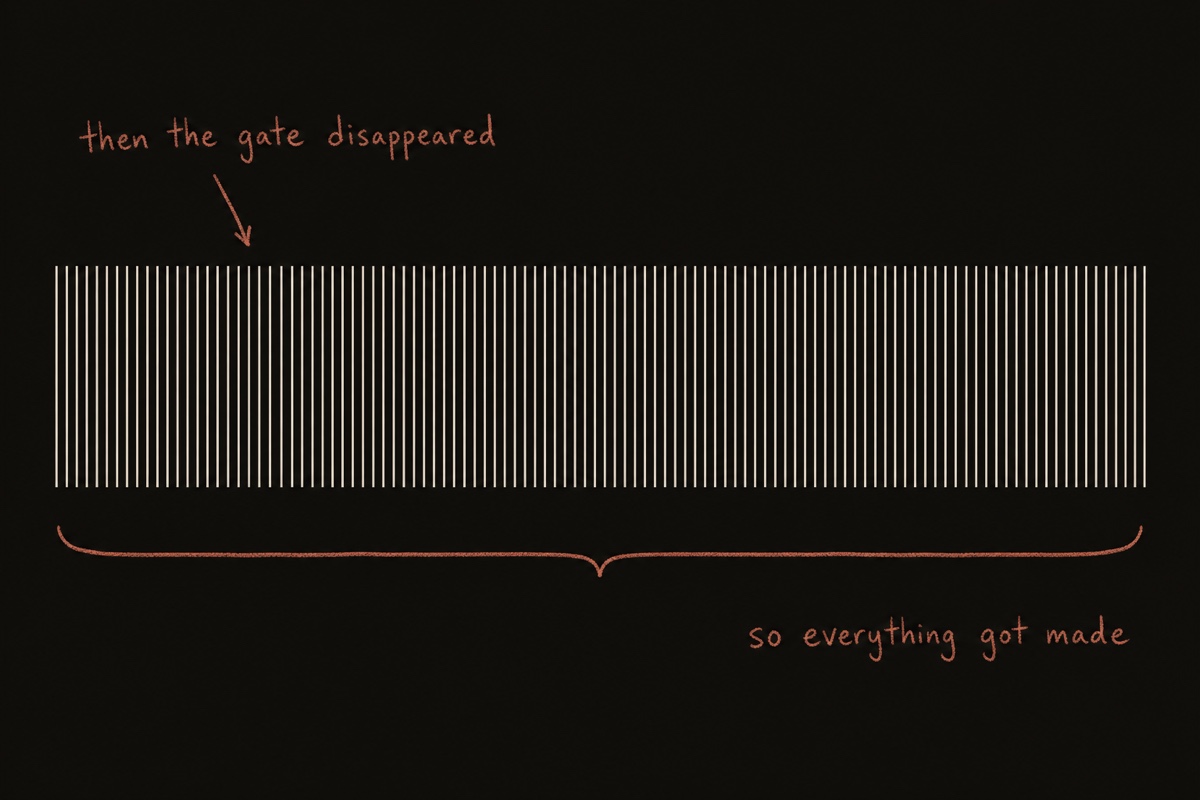
What I have watched happen, in businesses of quite different sizes, is 'proliferation'. More posts, more channels, more landing pages, more sequences, more experiments running at once. The output of a marketing department, produced by two people who also do everything else.
It would be easy to read this as a failure of discipline. I do not think that is what it is. Each decision passes its own test. A new page costs almost nothing and might bring in something, so the expected value is positive and you make the page. The same reasoning holds for the next one, and for the one after that.
The logic works decision by decision and fails in aggregate. Nobody chose to have fifty pages. Each of the fifty was defensible on its own, and the costs of having them arrive later, in a different month, detached from the decisions that caused them.
Noise
Two things follow, and they are easier to see in other people's businesses than in your own.
The first is that most of the noise is not yours. The environment you are trying to reach is being filled in by everybody else's newly cheap activity at roughly the same rate as yours, which means the returns on any given tactic fall while your use of it rises.
The second is that widening access to an activity tends to destroy whatever the activity was signalling. A genuinely personalised outreach email once carried information beyond its content. The recipient could infer that somebody had read their site and spent twenty minutes of a real working day on them, because at the time there was no other way to produce that email. The inference no longer holds, and the gesture has lost most of its meaning while looking exactly the same as before.
What stayed expensive
Production got cheap. A short list of things did not.
Attention did not. Coherence did not, by which I mean a customer's ability to form one clear idea of what a business is from a growing number of contact points.
And the obligation attached to everything a business puts into the world did not. A page is cheap to produce and not cheap to own. It has to stay accurate, stay consistent with the pricing, and stay recognisably the same business as everything around it. Multiply that by fifty and a business has quietly taken on a maintenance load it never agreed to.

The question changed
Which brings me back to the conversation I started with.
Something has shifted in how founders and business owners respond to a proposal. Telling someone you could build them a website, run their social accounts, or produce a steady stream of articles used to be close to sufficient. The capability was the offer.
Now the same sentence tends to meet a version of the same reply. Anyone can do that. So what does it mean for me, and why would I do it with you.
That reply is more significant than it first appears. It is the question that used to have to be asked on the business owner's behalf, and it now arrives unprompted. The interrogation has moved inside the business.
There is an asymmetry here that qualifies the whole argument. This has appeared in buying well before it has appeared in doing. The same owner who interrogates a proposal carefully will approve thirty pieces of internal output without asking any of the same questions. That is not surprising. When somebody asks you for money, the question surfaces by itself. When the activity is internal and nearly free, nothing forces it.
Choosing well
So the useful question is what actually has to be in place before a business can choose well, because 'selectivity' on its own is only a behaviour and can be done badly.
It needs something upstream of it. A business that declines things without being able to say what it is declining them in favour of has replaced one kind of drift with another. 'Strategic clarity' is the part that makes a refusal mean something, and it is usually the missing piece rather than the willingness.
It also has to be exercised locally. 'Judgment' resists generalisation, because the right answer for a business with an established audience is frequently the wrong answer for one with none. Advice about what to stop doing travels badly for this reason.
And it operates at two different scales, which are worth keeping apart. Deciding whether a business should be publishing a weekly newsletter at all is a different act from recognising which of three drafts is the good one. The second is 'taste', and its value has risen sharply, because the volume of nearly-good material a business now has to sort through has risen with it. A founder producing four times as much output is making four times as many of these small calls, mostly quickly and mostly without noticing.
There is one further thing, and I suspect it is scarcer than any of the above. Most businesses already know they are doing too much. Knowing and declining are separate acts, and declining costs something visible while a competitor does the opposite.
What follows
I want to be careful about the claim. Accessibility does not produce selectivity on its own. Nothing about cheap execution makes anyone thoughtful, and a great many businesses will use abundance to produce a larger volume of things nobody wanted, indefinitely and profitably. Volume also still works where the audience is a system rather than a person, and testing at scale genuinely requires quantity.
The narrower claim is the one I would defend. Abundance makes selectivity more valuable and more necessary without making it more likely.
What has happened is that a job changed hands. The barrier used to decide what a business would not attempt, without being asked and without being paid for it. That decision has come back in-house at the exact moment the number of available decisions multiplied.
One test I have found useful. Look at what a business currently does and ask which of those activities anyone would start today if the old price came back. The list is usually short, and the distance between that list and the real one is a fair measure of how much of the work is happening out of capability rather than intent.